

Description
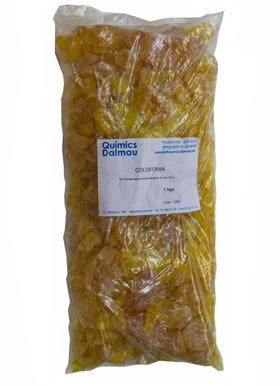
A hard, acidic, transparent reddish-yellow diterpene resin obtained from the resin of certain pine species; easily fusible, it produces brittle films that soften at low temperatures. It was used for the manufacture of oil varnishes in antiquity, and also in mixtures with wax, as an adhesive, binder, etc. It is supplied in brittle, glassy fragments. It is soluble in turpentine essence, alcohols, ketones, aromatic hydrocarbons, and chlorinated solvents. Furthermore, it is a fundamental component for soap production through the saponification of fats, as otherwise the soap would become rancid. It provides softness and a pleasant scent.
It is also used in climbing, available in powder form with or without magnesium, to coat hands and make them more adherent to rock. It is also used as glue for bookbinding. Similarly, ballets or dance groups use it when certain venues or presentation stages are slippery. Dancers step on this resin before going on stage to prevent falls.
It is also used, together with potassium chlorate and lactose, to produce the ‘fumata blanca,’ the white smoke that announces to the world that the Catholic Church has a new Pope.
It can also be dissolved in a bain-marie due to its own temperature.